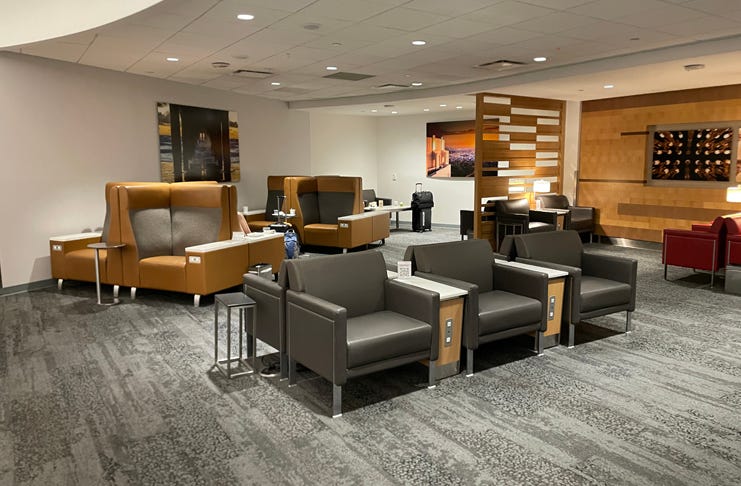
Welcome To The Lounge
We all live in the airport now.
In late 2021, as some Covid variant or another tore through the immunity of my friends and acquaintances, I was lured into the American Airlines Admiral’s Club lounge by a discounted single day entry deal. I’d sprung for the still-pretty-expensive day pass, telling myself that it would allow me to social distance and avoid spending the first days of my trip home probing every throat tickle for signs of sickness, but secretly, I’d always wondered what luxury was hidden within.
I’d assumed that airport lounges were a place of opulence. I had imagined them looking like sleek hotel bars where rich guys could do light insider trading over martinis. What cocktail would I order? Which of the many beautiful vintage chairs would I sit in? Would I blend in with the wealthy guys or be immediately identified as a day pass holder by my stunned gawking?
Outside the lounge, my hyper-inflated airline ticket only bought me the privilege of being barked at or worse by federal agents, buying a twelve dollar bottle of water, and shambling with dead eyes through what seemed to be eternal construction, all in search of a place to sit that I knew I’d never find. Surely, the airlines saw thsi as their chance to set things right. Surely, the inside of the lounge would be a salve to this humiliation ritual. Right?
Wrong. It’s a big room full of chairs that, because of the financial barrier to entry, wasn’t quite as overcrowded as the other big rooms full of chairs at the airport. The Lounge’s amenities were all mostly things a functioning airport would be able to provide in abundance: clean bathrooms, places to sit, and some complimentary food, none of which scream luxury. My dreams of opulence were dead.
The only thing in the lounge that even attempted to make me feel as though my money had been well spent was a complimentary chilled ceviche bar, the presence of which was so dissonant that it felt like a mockery. It seemed like a sort of fly paper for fools like me, who were not yet familiar with one of life’s great lessons: there’s no such thing as free shrimp at the airport.
The ceviche isn’t for eating, not really. It’s an exhausted show of feigned affection, a bouquet of flowers tossed onto the table by a man who hasn’t loved his wife in a very long time. Here, it seems to say with exasperation, will this make it all worth it?
The product that airport lounges offer turned out to not be a luxurious alternative to the airport, but rather a fulfillment of what reasonable expectations for an airport would be. The experience is defined not by the consumer’s objective standard of a fancy lounge (a club for admirals!) but by the neglected hellscape that surrounds it.
In that moment, I knew that dark math had been done in some distant office building, math that triangulated the exact overlapping point at which an airport was too humiliating for people with disposable income to endure but just serviceable enough to keep those without that disposable income from straying to car travel.
This is the forbidden magic of the real world, a brand of analysis that seeks to optimize the diminishing of our communal standards. It should offend like necromancy. These profane analysts have realized that The Lounge is only a respite as long as the airport’s an ass. If the latter is ever improved, the former would have to be as well and that costs money.
Unfortunately, this is the principle on which the entire world now runs. Enshittification, the short-term-profit-driven drop in the quality of everything , is no longer a theory. It’s just part of life. Whenever a new industry’s quality starts to dip, these financial necromancers begin drawing circles in blood and looking for new and novel way to reanimate the bones of better times.
What really broke me about entering the airport lounge wasn’t its mediocrity, it was the knowledge that a more functional airport can and does exist. Now, each time I entered the regular one, I’d be tempted to throw down sixty bucks to live in a world where I deserve decent things. I knew that I’d be going home to google how much one of those credit cards that gets you unlimited access costs. My wife and I would waffle back and forth on the frivolousness of the expense, eventually caving during a summer that necessitated we travel to weddings not once or twice but four times. The deciding factor? The card would give us a free checked bag, another amenity we could’ve sworn was once included with the cost of our ticket. This savings meant the card would basically pay for itself!
Where once, companies would compete with each other, developing whole marketing campaigns to convince us that their vision of the future was the most promising of the bunch, now they just zero in on whatever particular strand of the pre-2020 social contract has most recently frayed and offer to slow inevitable unraveling for a recurring monthly fee.
Uber, The Cab Company That Hasn’t Gone Out Of Business
DuckDuckGo, The Search Engine Without AI Bloatware
Organic Valley, The Milk Without Homunculus Juice
Years later, I’d look over the bill for my Lounge Access credit card and evaluate my ever-thinning budget to make space for ludicrously priced childcare, gas, and groceries. Auditing my addiction to a functional world, I’d wonder how many airport lounges lie in plain sight. How many of our monthly expenses are the result of someone monetizing our self respect?
And if the financial pressure of that self respect ever gets to be too much, if our desire for a functional world ever interferes with our ability to be good consumers, they’ll jump straight back to reframing these expensive services as the boondoggle luxuries of a generation that’s had it too good for too long. The high end degrades and with it the baseline expectation for quality. As always, its those at the low end who suffer most, fed lettuce that kills you, harvested by prisoners. The words of Mad Max: Fury Road’s Immortan Joe seem likely to be delivered without irony by a dead-eyed tech founder sometime soon: do not get addicted to water, lest you resent its absence.
Ultimately, people like myself (and really anyone above the age of 25) are a temporary problem for these companies. The end result of enshittification will be a generation that no longer thinks they’re owed a functional world. Taste and expectations will diminish until today’s elementary school kids are happily watching AI fruit videos with a tall glass of pesticide milk. I shudder to think of the airport that awaits them but in the interest of finding a bright side, maybe they’ll be better adapted to live in the world we left them.


