A Life On Two Screens
As A Difficult Year begins, I address the fact that I'm an adult iPad baby
We live in hyperbolic times. The attention economy rewards our ability to attract eyes above all else, and going on twenty years into living algorithmically sorted lives, we’ve adjusted our language accordingly. We started by brutalizing perfectly functional words like “friend” and “literally” to the point where they lost all meaning. Then it spread to how we discuss media and current events. A new album can’t be good, it must be important. A movie can’t be bad, it must be problematic. Everything must be placed in moral or political terms so that it either indicts or exonerates its audience, urging them to repost in affirmation or furious disagreement. We seem increasingly unable to just let something be mid and move on.
We all understand this on some level and have learned to mentally adjust for linguistic inflation. That new movie with a 100% score on Rotten Tomatoes will probably just be pretty good. The supposedly cancel-worthy remarks of that young actress are more likely to merit an eye roll than a call for her deplatforming. There’s no shortage of mediocrity hidden behind outsized language but what’s truly interesting is when that presumed tepidity hides something that actually merits the language of a five alarm fire.
When people talk about being “addicted” to phones, screens, or dopamine, there’s always been an implied hyperbole. Years ago, when our phones were more tethered to tangible social and work lives, the way we talked about them was similar to the way Americans talk about being busy or tired. It’s something people tend to frame as a complaint or a flaw that has a deeper social utility of implying that they are important in some way you haven’t considered. Because of this early tendency, I think many of us began to write off what has since become a very real and tangible addiction.
This can raise some eyebrows. Addiction is a serious thing, am I really trying to compare being on my phone too much to something that ruins lives? But if you look closely, addiction is all around us. In fact, 21st century America loves nothing more than getting us casually addicted to something. Cigarettes, sugar, and weed addiction don’t get a lot of salacious movies made about them, but going cold turkey off of any of them causes observable withdrawal symptoms. Socially acceptable addictions just don’t tend to merit interventions. But intervention can still be necessary.
Have you tried taking away an eight year old’s tablet lately? Have you tried taking away your uncle’s?
The first time I felt powerless in front of a screen, I was somewhere around nine years old. Up until this point in my life, the computer had been a source of occasional entertainment in the form of various CD-ROM games and was considered a neutral (maybe even educational!) presence in our home.
But that was about to change with the introduction of Neopets. The website, launched in 1999, was essentially an attempt to ride on the coattails of Pokemon’s massive success. Users could adopt cartoonish pets, give them names, and battle with them. While it seemed like a game on a surface level, it was something slightly darker: proto-social media for children. The pets were the reason everyone was there, but each user had an individual profile and the ability to send messages to others. It even had its own version of an endless feed in its “NeoBoards” feature. This is where the real hooks sunk in.
Some threads were conversation starters, but most were just people’s loose thoughts. Each press of the refresh button refilled my screen with more strange perspectives to embody. Over twenty five years later and I still remember thread titles like they’re my friends’ old phone numbers.
There was so much to read, so much to consume, and the time would flow away like it was nothing. It silenced my thoughts and without knowing what I was giving up, it felt like a respite from the developing neuroses that I was still mostly keeping to myself. The screen became a bright, beckoning light in my living room, a sun I could stare into with impunity and vanish for a moment. When I did, I’d lose myself for a moment, becoming everyone and no one. Eventually, it was harder to pull myself away.
One afternoon, my internet connection was struggling to keep up with my browsing. The page loaded slowly, producing a small rectangle of new information every thirty seconds or so. I realized at some point that I didn’t really want to be on the computer anymore. Maybe I had to go to the bathroom, maybe I wanted to play with my cat, who knows. But despite the fact that I no longer wanted to be on the computer, I couldn’t bring myself to look away from my slow drip of internet.
I had to see what came next. On the ratty old ottoman that used to serve as our computer chair, I began to rock back and forth, feeling increasing physical discomfort. In that moment, as I swayed and shot furtive glances around the empty room, it dawned on me that I wasn’t in control anymore. I knew that I was powerless to leave that screen before it loaded.
Luckily for me, my unfettered Neopets access was soon revoked after my parents got a glimpse at how inseparable it and I had become. This was a major reevaluation of the computer and its role in my life. Up until that point, the pre-internet era computer had been a purely educational device in our home. I used it to play Wishbone’s Odyssey, Math Blaster, and Titanic: Adventure Out Of Time. I’d boot up Encarta 95 and recreationally read the encyclopedia entries for various whales. If your first exposure to the computer was seeing your kid overflowing with new whale facts to share with you, I find it hard to believe you’d sit down and try to predict all the ways the machine may eventually try to lay eggs in his brain. This moment in which my parents saw that my relationship to the website was more addictive than recreational was the first time the computer had seemed like an object with a will of its own.
Unfortunately, despite my parents’ best efforts, the world quickly made it impossible to keep me away. Once the mid aughts hit, I found myself in high school and the social media craze had begun in earnest. Socializing happened online and to deny your teen the right to explore this new frontier was to shrink their world (or so we all told our parents in desperation).
With the arrival of MySpace and Facebook, I could mainline the lives and uncensored thoughts of my classmates. I could be a part of everything. I could know who believed what and who was friends with whom. I could peer into other peoples’ lives and invite them to peer into my own, all while turning off the stream of anxious thoughts that grew louder as puberty took hold. It wasn’t so different from my Encarta days, so long as you were okay with replacing the sum total of scientific and historical knowledge with the unfiltered thoughts of Midwestern teenagers.
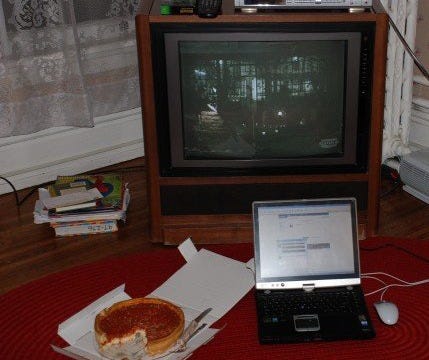
I’d just learned the shameful joy of the notification, that little flare of feeling you get when a number appears in a little red bubble. My OCD-driven love for creating rewarding feedback loops made me a quick study on how to make that number go up. I did this either by interacting with everything that came across my feed or by creating content of my own to get people to interact with me. I’d make Facebook groups with funny titles and invite half my class. I’d photoshop bizarre profile pictures that I knew would get attention, positive or negative. I’d constructed a corrosive algorithm in my own mind and was serving up content to please it. It worked. But as I manipulated the computer, it manipulated me. Before long, I regularly took part in the act of “second screening,” dividing my attention between multiple screens, placing my real life further and further behind them.
The internet was pure, bright, and uncomplicated. You could learn how it worked and get it to do what you wanted. And for those of us with racing thoughts and anxious minds, there was finally a device capable of keeping up with us. Scrolling endlessly, I would experience something akin to ego death. I shaved off parts of myself and left them online for all of you. I didn’t think I needed them.
My first post-college online projects, goofy little parody Twitter accounts and Facebook pages, raked in hundreds of followers, then thousands, then hundreds of thousands. I somehow built a career on posts, renting out my uncanny ability to stare at the sun and return with insights on culture. As it turned out, that’s just what Marketing was now. In my mid 20s, I got a job second screening dozens of hours of unreleased television shows and movies in one window while I noted the parts most likely to elicit a strong response from online fan communities in the other. Naturally, I’d do my own social browsing on a second monitor.
I always knew that I was at the upper end of the norm for internet users, but it wasn’t until the pandemic, as I complained to my wife about an affliction I’d come to call “Screen Face,” that I was able to finally admit to myself that I’d become the digital equivalent of a pack-a-day smoker. Symptoms of Screen Face included a foggy mind and bleary, hard to focus eyes that seemed to continually search for a screen in the middle distance that wasn’t there. I complained about this affliction like it was something that happened to everyone, but she had no idea what I was talking about.
I wish I could say there was some crystal clear moment where I realized the problem, met it head on, and fixed it. Instead, it just became a source of shame. “You’re too online” was just another intrusive thought, another anxiety that I could turn if only I could just get a little more online. I remained online. I still am online. But now, it disgusted me. If I had to attempt to pinpoint when it happened, I’d say it was after the whole Bean Dad fiasco, when I wrote this piece. Having called my own attention to my addictive relationship with posting and scrolling, I didn’t see a silly Main Character incident. I saw a multi-billion dollar corporation ring a dinner bell, throw an old steak into the street, and watch us all fight for a chance to wrap our teeth around it for a moment.
I shudder to admit that I once thought that we were doing something special online. I thought that posting was inherently creative and that time spent on platforms like twitter could constitute artistic expression. I’d say we were playing with language, writing poems, or communally contributing to some new comedic tradition; it really depended how many beers I had in me. But when the pandemic sent us all more online than ever before, all I could see was the hollow, addictive nature of everything our devices had trained us to do. I knew in my gut that this wasn’t the form any of this is supposed to take. Everything felt like a hollow pursuit of dopamine and attention. I watched so many talented people start crying into front facing cameras and I couldn’t summon up anything other than cynicism and shame. But this was just another step in the addiction process. Though I’d lost the will to post, to “join the conversation,” I still maintained my need to scroll. There was no desire for creation left, only consumption.
Maybe my story is familiar. Maybe it’s not. But in the serious efforts to be on my phone less that I’ve taken over these last few years, I haven’t had much else to do but watch you guys. I’ve seen your thirty part Instagram stories and your 50 Bluesky posts a day and I’ve taken the gamble that many of you might relate to this more than you’re willing to admit.
The problem isn’t just that screens are bad for us, the problem is that the screens are too good. It’s not that phones can kill us or that our gaming PCs will make us forget to eat, but that in aggregate, the presence of an eternally “better” option, one of perfected leisure that hijacks every impulse in our minds to make us feel at peace, will never not seem preferable in comparison with the friction of the real world. Your family might say things that annoy you, dates might not go well, but a few more hours scrolling could take you anywhere.
Brain worms, irony poisoning, we’ve given the new sickness of the internet a lot of cute little names but what it really boils down to is a surrender of the self. Like any good addictive substance, the internet promises oblivion to those who seek it. When we scroll, we are gone. We’re not embodying ourselves or experiencing things from our own perspective. Instead, we’re living as an eternal voyeur, a silhouette in a dark theater.
We will never get to that white hot core of the internet but if we aren’t careful, we’ll waste our lives chasing after it. Life will become like an episode of streaming television, something that plays in the background while we space out. When we finally do look up, we may well realize that the entirety of our physical lives was deferred to a tertiary plane of attention. Turns out that if you spend life second screening, there is no first screen, no primary focus. There is just a person’s perception, all they’ll ever know of the world, being asymptotically divided over and over again until it’s spread so thin it may as well have never existed.


As someone very much in the latter stages of “watch, but very rarely post”, this once again absolutely nails it. Social media increasingly feels like such a transparency poor simulacrum of any form of interaction, even in advertising and algorithm free settings such as Mastodon. The dopamine hit has long since gone - it’s just habit at this stage
I personally have very limited real world social opportunities (chronic illness/low spoons), so I think there’s still value in “room scale” environments, such as group chats or Discord, but that feels different - for me at least, there’s thankfully not the same reflexive urge to refresh to see what’s next.